Saturday, January 9, 2016

6 Budgeting Tips to Help You Save for a Down Payment

6 Budgeting Tips to Help You Save for a Down Payment
Saving enough cash for a down payment may seem impossible, but with planning and discipline you can make it happen. It might not be tomorrow, but owning your own home is something worth waiting for, working for and, perhaps, sacrificing a few expensive coffee drinks for as well. Here are a few tips to help you get started.
1. Track every dollar. Find out exactly where your money goes each month by keeping track of every single thing you purchase over 30 days. Review your card and bank statements carefully to categorize where you spent each dollar (e.g., entertainment, food, clothing). Sites like mint.com can also help you track and categorize spending.
2. Rate every purchase. Using the month of expenditures, rate each item or service you bought as a "want" or a "need."
3. Set savings goals. Using your "needs" and "wants" list, determine where you can realistically cut spending. If it means that much, you don't necessarily have to cut out Starbucks altogether, but reducing your trips will certainly help. Use the budget to set monthly and yearly savings goals.
4. Set aside funds. Create a separate savings account for your down payment. It's not only easier to track, but blocking off the funds may make you think twice before dipping into that money for something other than your future home.
5. Save automatically. If you are paid through direct deposit, chances are you can split your paychecks into more than one account. Set up your new "down payment" savings account to take in a portion of your regular direct deposits. You can't miss money you don't see in the first place.
6. Maximize your returns. Once you have a bit of money saved, talk to a financial professional about other places you might invest it to get a bigger return than you would by keeping it in your savings account – perhaps a money market account or a certificate of deposit (CD).
When your down payment goal is in sight, find a Realtor who will help you take the next step in your home buying journey. Find a local RE/MAX agent who can help.

Friday, January 8, 2016

4 Resources for First-Time Homebuyers

4 Resources for First-Time Homebuyers
Surveys show that first-time buyers aren’t aware of how much they need to save for a down payment. Many people believe that buying a home requires they put down at least 20 percent of the purchase price, but down payments aren’t as big of an obstacle as people think. For example, a loan through the Federal Housing Administration could require a down payment as low as 3.5 percent; Fannie Mae and Freddie Mac have similarly low requirements.
If you qualify for a loan with a low down payment but still have trouble coming up with the cash, here are a few of the many programs out there that can help. Do some research to find out what’s available in your area.
1. Help getting down
The federal Department of Housing and Urban Development (HUD) gives community development block grants to states and local governments across the country to help revitalize certain areas. HUD’s HOME Investment Partnerships Program (HOME) is one such program. States often have their own programs for down payment assistance, too.
2. Opening up options for closing
The Federal National Mortgage Association, a.k.a. Fannie Mae, designed the HomePath Ready Buyerprogram to attract new homebuyers to the market. Through the program, qualifying first-time homebuyers can get assistance of up to 3 percent of closing costs after they pass an online homeownership course.
3. Making ownership less taxing
Some state governments provide first-time buyers with a tax credit to boost homeownership.
4. Helping heroes
The U.S. Department of Veterans Affairs (VA) Home Loan Guaranty Service helps veterans or surviving spouses obtain better terms for their mortgage by guaranteeing a portion of the loan. Some VA mortgages require no down payment.
Check the National Council of State Housing Agencies for more opportunities available in your state.
A buyer’s agent will be able to help you find the programs that operate in your area and are appropriate to your financial situation. A great agent is easy to find here.

Thursday, January 7, 2016

Owning a home helps you building family wealth

Real Estate Shines as an Investment in 2015

Real Estate Shines as an Investment in 2015 | Keeping Current Matters
A survey by The Joint Center of Housing Studies at Harvard University reveals that when a family is buying a home they consider the financial benefits of homeownership along with the social benefits. The survey mentions things like:
  • Paying rent does not make sense
  • Homeownership provides a good financial opportunity
  • Owning a home helps you building family wealth
  • Buying a home is investing in your retirement
  • Home equity gives you something to borrow against
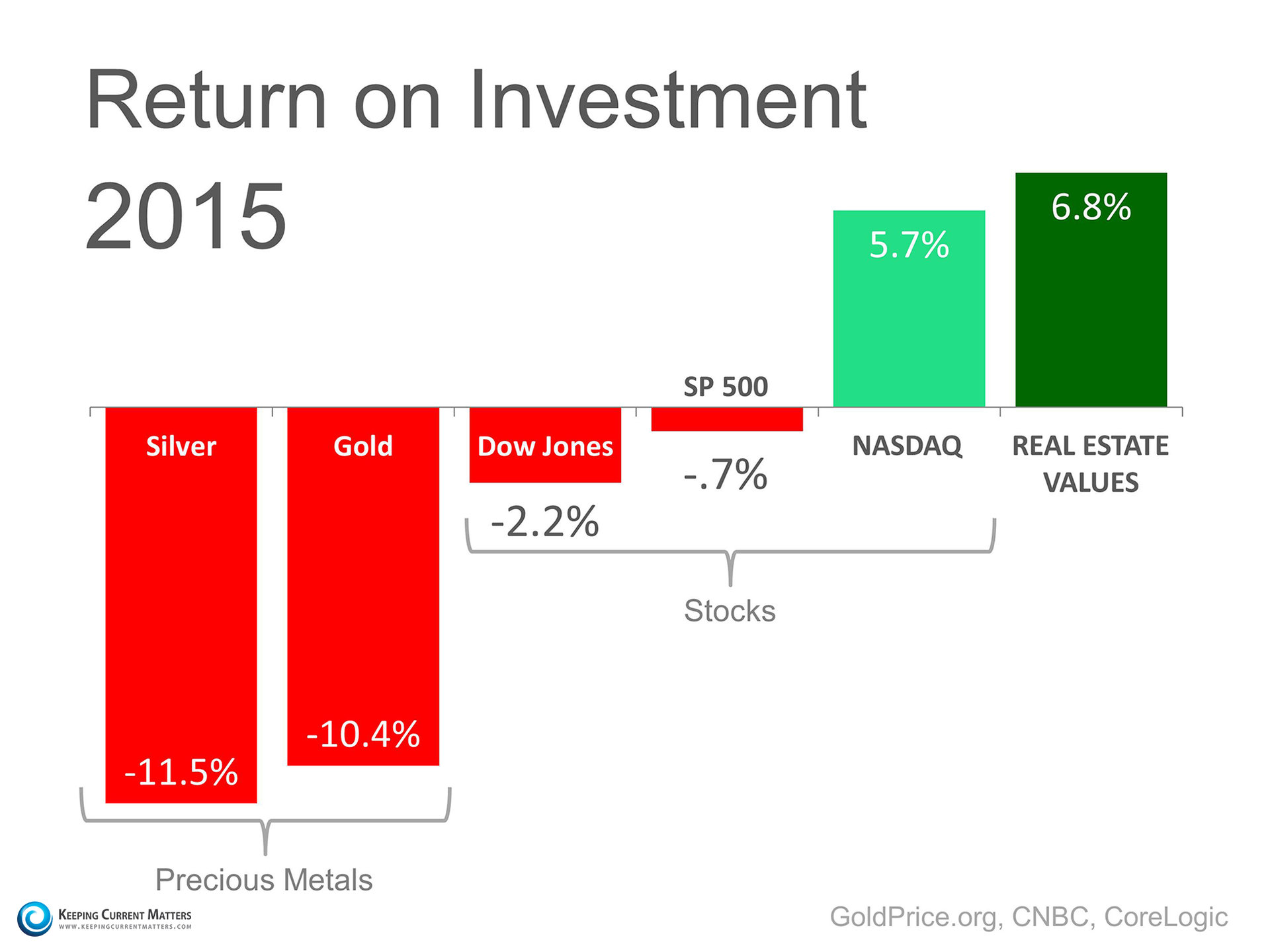
So how did homeownership match up against other investments in 2015? Here is a chart that compares its return on investment against precious metals and the stock market last year:
2015 Return on Investment | Keeping Current Matters

Bottom Line

Not only did homeownership offer all its social benefits. It also was a great investment financially.

5 Winning Tips for Writing an Offer Letter

5 Winning Tips for Writing an Offer Letter
In some hot housing markets, including a letter with your formal offer to buy a home is all but required. Unfortunately, Hallmark doesn’t make a card for the occasion (yet). Here are a few tips:
1. Get emotional.
Take advantage of this opportunity to sail beyond the facts and figures to convey a personal connection to the home. Pick one or two features and talk about how they fit into your vision of the perfect home. For example, “Holiday meals are important to my family. Your large kitchen has everything I need to re-create my grandmother’s recipes, and would fit all of my relatives who like to gossip while cooking.” Or, “During our showing my children escaped to climb trees in your back yard. They fell in love with the home as much as I did.”
2. Connect with the seller.
Find one or two similarities between your family and the seller’s, based on what you can discern from the home. Show you have something in common, but be careful not too dig too deep (nobody wants to sell to a stalker). For example: “We’re so excited that your home not only has a beautiful, fenced yard, but also a dog door. Our lives revolve around our two rescue pups, Sonny and Cher, who would literally leap for joy in a yard of their own.”
3. Don’t be afraid to flatter.
Tell the seller why you adore specific features that have been upgraded: “We love those colorful tiles you used on the kitchen back splash. They remind us so much of our honeymoon in Portugal.”
4. Don’t whine.
This is not the place to play the sympathy card. No sob stories about why you sold your last place, or how many deals have fallen through. You want the seller to feel good reading your letter.
5. Grammar matters.
Check spelling and grammar. Have a grammar-nerd friend triple check it for you. You want the seller to know you put time and care into your honest appeal.
Not sure where to start? Find a local RE/MAX agent who can help.

Wednesday, January 6, 2016

NEW LISTING IN ERIN, WI FOR SALE NOW

A parklike setting with 3 acres is the setting for this beautiful 4bedroom, 2.5 bath home. Home features include granite, HWF, inviting foyer, formal living room and dining room, family room with NF and wall of windows sunroom overlooking yard. Bathrooms all ceramic. Spacious Master suite w/HWF Detached extra heated garage/workshop with electrical and water. Included Home Warranty
Contact me at 262-893-5555 for a showing!


Sellers: How to Decide Between Multiple Offers

Sellers: How to Decide Between Multiple Offers
What a splendid dilemma! You’ve received several offers on your property. Which one should you choose? It’s not always the highest one.
Here are just some of the areas your agent could ask you to pay particularly close attention to as you're weighing the options.
1. Do the math.
This goes beyond simply calculating the dollar difference between the various offer prices. Before you do that, be sure to do all the math. Subtract things like closing costs, fees and potential repairs to determine the net proceeds of each offer.
2. Consider the financing.
Can the buyer provide proof from the bank that there are funds to back the offer? Your agent can help verify this – and help you understand the terms of the buyer's financing.
3. Motivation.
Do the buyers have a baby-sitting parent in the neighborhood? A new job just around the corner? Buyers with extra motivation to purchase your home are less likely to press for concessions and more likely to work harder to close the deal. Some buyers even include a personal letter with their offer to explain why they want the home. These letters can be particularly helpful in multiple-offer situations.
4. Timeline.
Note the closing date each offer proposes. You'll want a closing date that best meets your needs. You can always counter a closing date, too, if the best offer doesn't quite meet your timeline.
Weighing the pros and cons of each offer can be tricky. An experienced agent can help you clarify, calculate and secure the very best deal for you. Find a local RE/MAX agent who can help.

Tuesday, January 5, 2016

6 Questions to Ask Yourself Before Buying a Vacation Home

6 Questions to Ask Yourself Before Buying a Vacation Home
Have you and your family fallen in love with a vacation spot and you're wondering whether it makes sense to buy there? Here are some key questions to ask yourself (And keep in mind that a great real estate agent can always help you talk through them!).
1. Do you really, really love the location?
It's a good idea to visit the area during the low season. Do you still enjoy it when the ski slopes are green, or when those ocean breezes are too chilly for lounging on the sand?
2. How often can you get there?
Calculate how many times a year you'll be able to use the home. Carefully consider the commute as well as your career and family commitments to determine how much time you realistically can spend there relative to the costs of owning and maintaining the property.
3. Have you talked to the locals?
Spend some quality time at the local coffee shop or microbrewery and chat with people who live in the area year-round. Ask them what they like, and don't like, about living there – and about any cultural trends they've noticed.
4. Could you rent your place if you had to?
Renting out the home when you're not there brings with it a host of other considerations. Does the HOA allow rentals? Would potential renters be interested in the property's amenities, such as a fireplace in a ski town or an inviting deck or patio in a beach community?
5. What about the taxes?
Taxes for a second home can be more complicated than those for your primary residence. Talk to a tax pro and learn more about the tax implications for your specific situation, including taxes on rental income if you plan to rent out the place for part of the year.
6. What's the tab when you're not there?
Calculate the true, year-round cost of owning the home, including utilities and property management when the home isn't occupied.
Looking for more guidance on vacation properties? Find a local RE/MAX agent who can help.